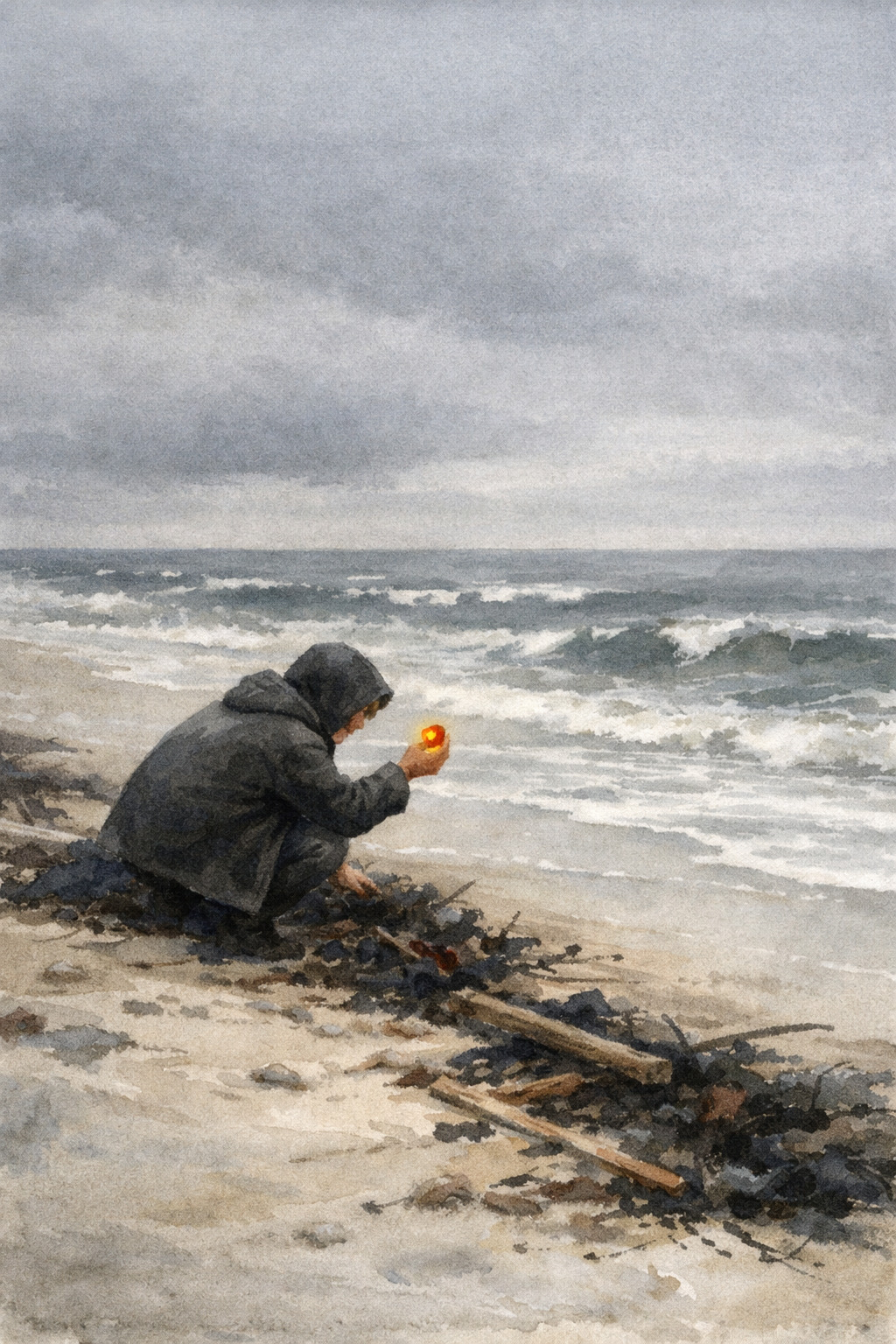
Vera arrived at the shore before the light was enough to work by.
She had driven the coast road from the town before dawn, the car's headlights picking out the pine trunks along the dune slope, the trees close and dark and the ground under them pale with dry needles. The storm had come through from the southwest in the night. In several places the road was crossed by thin tongues of blown sand, and she had driven over them slowly, feeling the grit under the tyres. She parked in the gravel turning area at the top of the beach access path, the same place she had parked for thirty years. No other vehicles were there. She was early.
She sat in the car while the sky lightened. The sea was audible through the closed windows: a continuous deep irregular sound, the heavy swell still running after the gale. She listened to the interval between breaking waves. They were arriving every two or three seconds, close together, which meant the sea was still high and steep. The storm had peaked overnight. By the time she arrived, the worst of the wind had moved east. But the waves it had built would take another day to settle.
She had been counting intervals between waves since childhood. Her grandmother had taught her this before she had learned what it was for. Later she understood: the interval measured the swell period, and the swell period told her how much energy the sea had received from the storm and how far out the storm had been. A short interval meant a local storm — waves steep and chaotic and the tide line unpredictable. A longer interval meant the storm had been far offshore, the swell well-organised, the energy focused, and the tideline rich.
Two to three seconds was local. The storm had passed directly overhead.