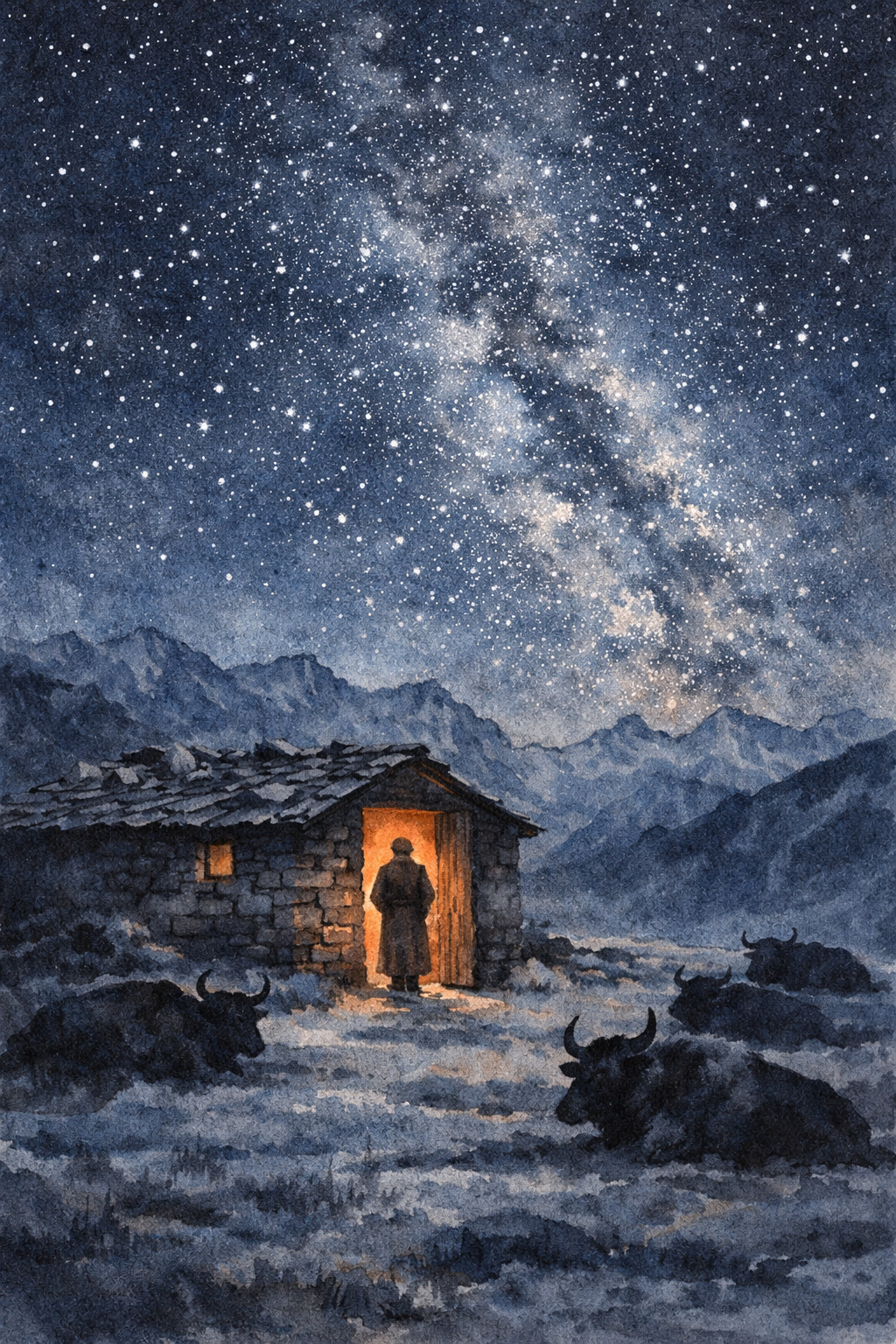
The night was still completely dark when Pemba Sherpa woke inside the stone kharka hut. He lay without moving for a long moment, listening to the familiar silence of the high pasture in late September. The yaks were calm outside, their bells giving only the occasional soft chime as one of the naks shifted her weight or turned her head in the darkness. He could hear them breathing collectively through the thick stone wall, the slow measured exhalations of large animals at rest on cold ground. The sound of them was exactly as it had been every morning of the past four months, unchanged and steady. He pressed his palm flat against the inside of the stone wall beside his mat. It was very cold, the cold coming through the rock in a deep even way that told him the temperature outside had dropped well below freezing in the night.
He sat up slowly and gathered his woolen chuba around his shoulders before standing. The chuba held the warmth of sleep for a few minutes after waking, which was enough time to get the brazier going. He had learned as a young man not to move too quickly at this elevation in the morning. The body needed time to understand that the night had ended before it could be asked to do much. His acclimatization had been complete since early July, when the first weeks of adjustment to the high altitude had finished their work on him and stopped requiring his attention. But the mornings at nearly five thousand meters still had their own quality, a deliberateness that the thin air imposed on everything, a slowness that was not fatigue but simply the nature of the place.
He found the small clay lamp on the shelf beside his mat and lit it with a match from the box he kept wrapped in oiled cloth to protect it from the cold damp. By its light he could see the interior of the hut well enough. His grandfather had built this hut on an older foundation, using the flat schist slabs that lay in abundance on the surrounding hillside. The walls were a meter thick and the ceiling was low enough that he had to duck slightly when moving between one side and the other. A small iron brazier sat in the center of the floor with a ring of flat stones around its base. He arranged a few pieces of dried yak dung in the brazier and coaxed them to catch from the lamp flame, blowing steadily and gently until the fuel took. The smoke rose in a thin straight column and found its way out through the gaps between the roof stones in the way that the construction had been designed to allow. Within a few minutes there was enough heat beginning in the small space to melt the skin of ice on the surface of the water pail.