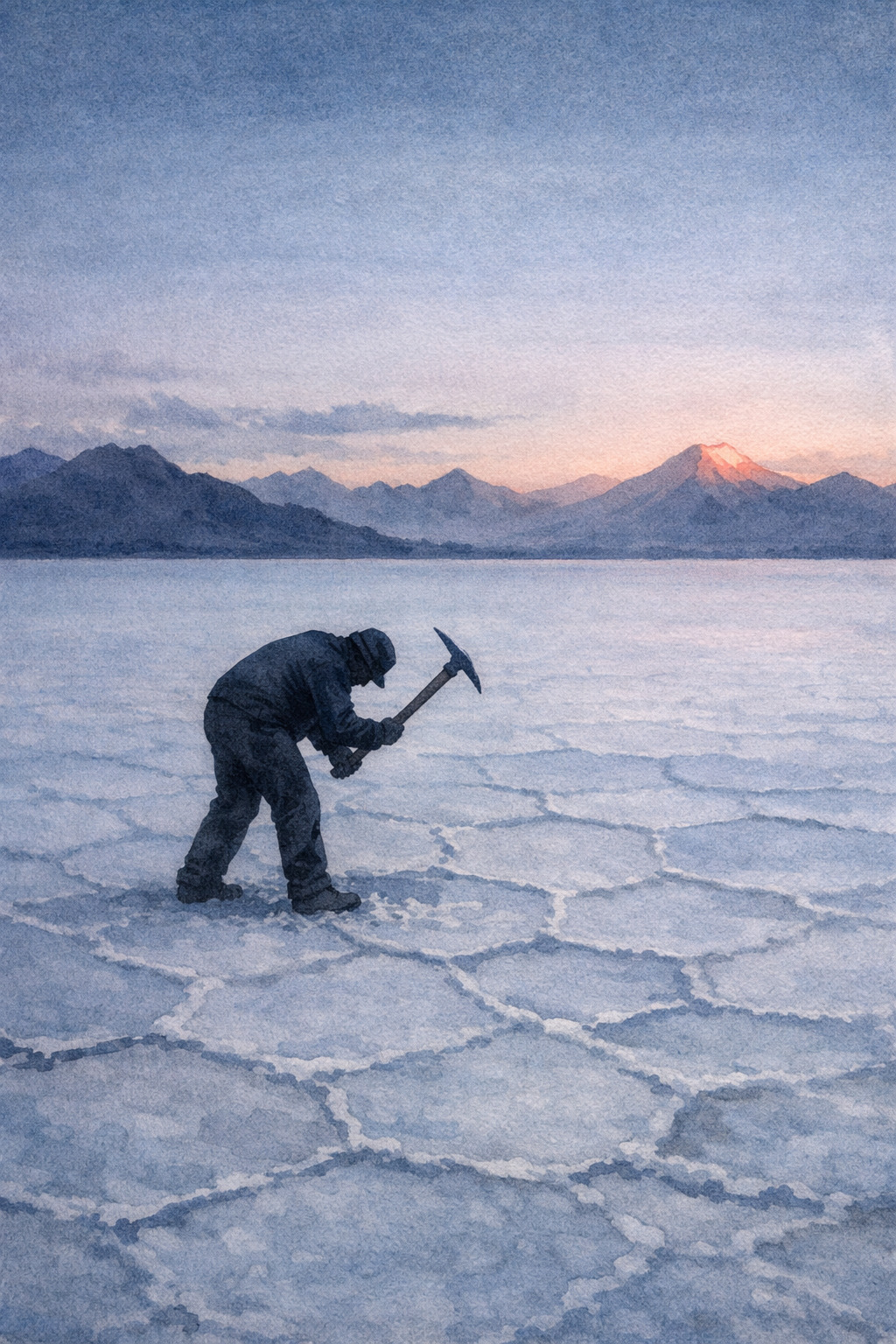
Celestino arrived at the flat while it was still full dark.
He had left Colchani on the bicycle at four in the morning, the road south through the village empty and quiet, the only sound the tyres on the packed earth and the creak of the frame on the rough sections near the plaza. He wore his ch'ullu — the wool hat with earflaps his wife had knitted — and over it the hood of his waterproof jacket. The pre-dawn temperature on the salar's margin was minus eight degrees. In summer, in December and January, it was milder. August on the altiplano was cold at any hour and coldest before the dawn.
Colchani was a village of perhaps seven hundred people at the salar's eastern edge. Most of the working men of the village made their living from the salt, organised through the cooperative that had existed in its current form for several decades. The cooperative assigned the sections, maintained the boundary markers, arranged the trucks that collected the dried mounds each afternoon, and managed the weighing and payment that closed each season's account. Before the cooperative the salt had been worked by individual family arrangements, the sections inherited and the prices negotiated privately with buyers from Uyuni and Oruro. The cooperative had standardised all of this.
He had ridden the road south from the village many hundreds of times. The road was a simple track, pressed into the clay margin of the salar by the passage of bicycles and trucks over many years. In the rainy season — November to March, when the salar sometimes flooded under a thin sheet of water and became the vast mirror that attracted visitors from other countries — the track became soft and impassable in places. In the dry season the track was firm and the bicycle moved quickly on it.