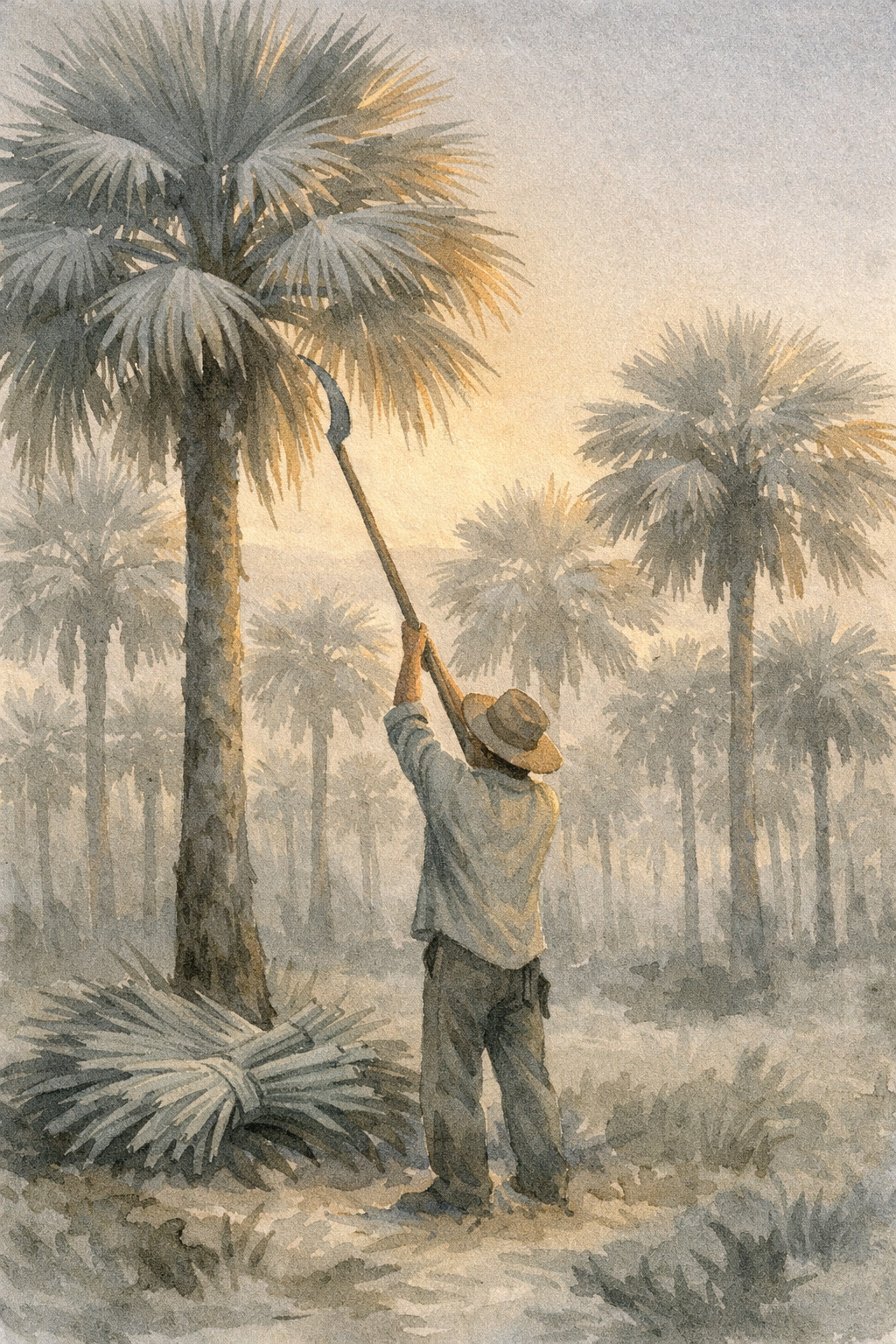
Raimundo left the house in the dark.
The dry season in the Ceará sertão produced a particular quality of night and early morning. Without humidity in the air, the darkness had a clarity that the wet-season nights did not have — the stars very bright, the shapes of the mandacaru cacti and the bare caatinga trees sharply outlined against the sky rather than blurred by any atmospheric moisture. The night was also cold by sertão standards, the heat that had accumulated in the ground through the afternoon hours radiating upward without humidity to retain it, the temperature dropping ten degrees between sunset and pre-dawn. He wore his work coat to the carnaubal every morning of the harvest season and removed it as the sun climbed.
The walk to the carnaubal took twenty minutes along the track that ran between the caatinga scrub and the edge of the várzea lowland. He carried the podão over his shoulder — the long cutting pole balanced at its midpoint so that the blade end rose behind him and the handle end dipped forward, the weight distributed evenly across his shoulder for the walk. He carried water in the canteen at his hip and nothing else.
The track was packed earth, pale in the dry months, the surface powder-dry and fine. He could not see it clearly but his feet knew it. He had walked this track at this hour every morning of the harvest season for many years, and the path had a texture his steps recognised without instruction from his eyes.