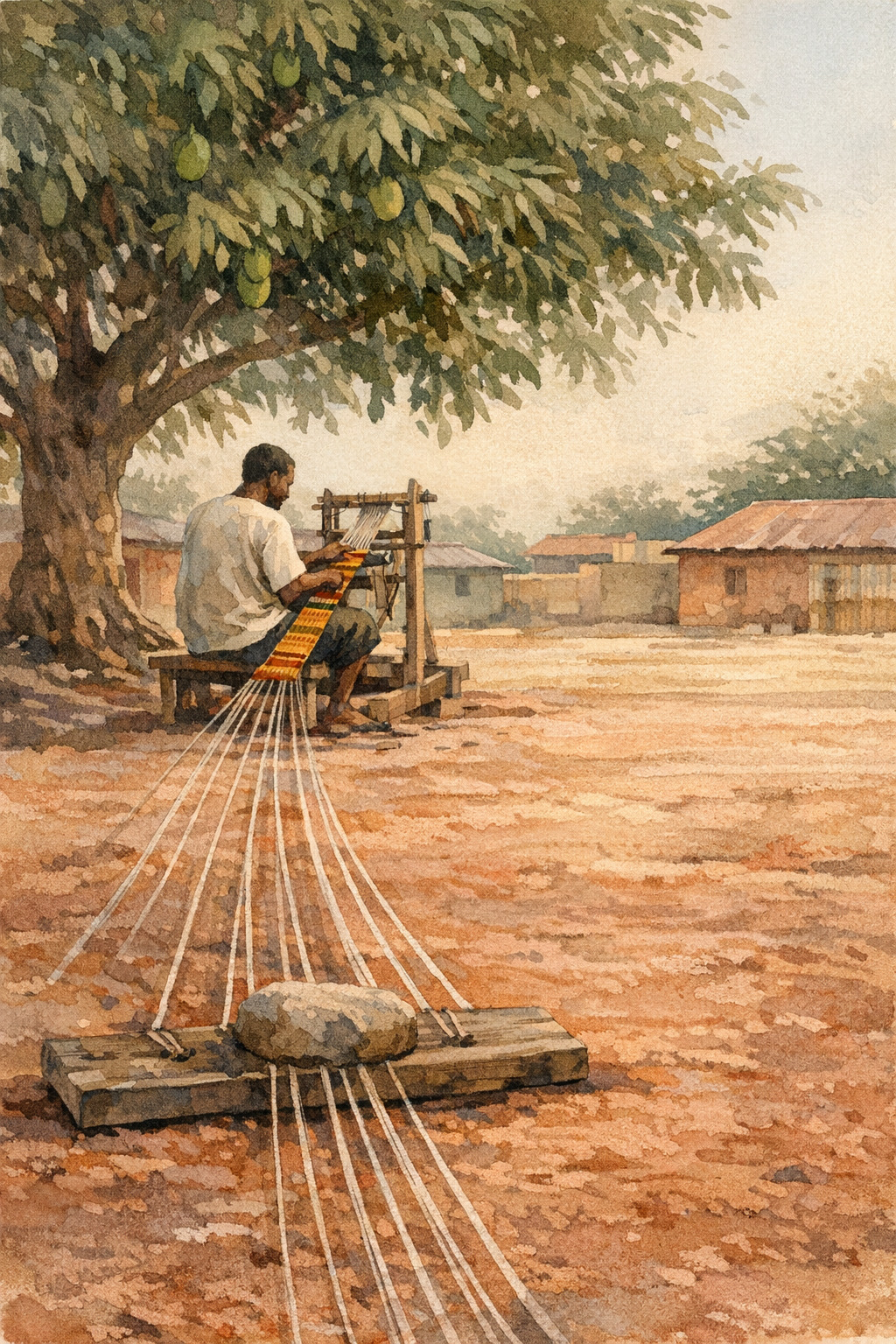
Kofi Mensah came to the loom while the compound was still dark.
The harmattan had been blowing for two weeks now. It came from the north each year, the dry wind out of the Sahara arriving in late November and staying through February or March, carrying its fine dust down over the forest country of the Ashanti hills. The harmattan changed the quality of everything. The air lost its wet-season weight. The mornings that had been warm became cold. The sky, which had been blue and full through the long rains, became pale and flat, the dust suspended in the atmosphere thickening the light until the sun appeared not as a sharp disc but as a brighter region in a uniformly white sky.
He had been waking into this same sky every harmattan for forty-seven years. It was the sky of his birth season. His mother had told him he had been born in harmattan, in a cold January in the main room of this compound, in the same room where he now slept. He did not know what it would feel like to wake into a harmattan morning in a different compound. He had never tried.
He crossed the swept earth barefoot, his sandals left at the house door. The soil was cold beneath his feet. Dry-season cold was different from wet-season cold. It had no moisture in it, nothing that chilled. It desiccated. The surface of the compound earth in harmattan season had a faint roughness, a powdery quality from the dust that settled on it overnight, and his feet registered this as they registered the cold: not with discomfort but with recognition.